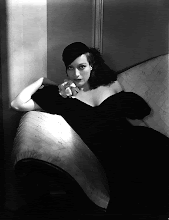
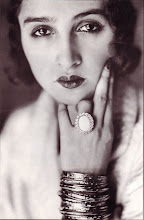
Cary Grant, Irene Dunne, you guess the movie...
Friday, 22 August 2008


Wednesday, 20 August 2008
Ask, and ye shall receive
Before I start sipping on my gin and tonic, here's a site I must look at later.
I came across this photo this morning and sent it to Orlando with a question mark.

Who is this dame?
Before the end of the day he had supplied me with the answer.
Bless.
PS I found another online article this morning which recommends Robert Giroux's 1991 book , A Deed of Death: The Story Behind the Unsolved Murder of Hollywood Director William Desmond Taylor. The article's author, Robert K. Klepper, claims that the book provides "excellent, reputable information, with well documented research". Who knew I was such a ghoul!
I came across this photo this morning and sent it to Orlando with a question mark.

Who is this dame?
Before the end of the day he had supplied me with the answer.
Bless.
PS I found another online article this morning which recommends Robert Giroux's 1991 book
, A Deed of Death: The Story Behind the Unsolved Murder of Hollywood Director William Desmond Taylor. The article's author, Robert K. Klepper, claims that the book provides "excellent, reputable information, with well documented research". Who knew I was such a ghoul!
George Hurrell (MGM)
(1904-1992)
At age 18, George Hurrell started out as a fine art painter, studying at the prestigious Art Institute in Chicago. In 1925, while still attending the Art Institute, the famous landscape painter Edgar Alwyn Payne invited Hurrell to Laguna Beach, California to be a part of the Laguna Art Colony.

George Hurrell painting a picture
In 1925, Hurrell also met Florence Leontine Lowe (Pancho) Barnes, who went on to become a highly accomplished aviator. Pancho and George became great friends. Three years later Hurrell photographed Pancho at home in Laguna Beach. She couldn’t believe how beautiful he made her look, and loved the photos.

Pancho Barnes
Ramon Novarro, a famous silent movie star at MGM, was one of Pancho’s best friends. With the transition to talking pictures, Novarro, who had a great operatic voice, was vacillating between staying in Hollywood or becoming a stage actor in Europe. Novarro wanted some dramatic photographs for his stage pursuits and Pancho recommended Hurrell. Novarro had a series of photographs taken by George Hurrell at Pancho’s homes in Pasadena and Laguna Beach, including one dressed as Percival, standing next to Pancho Barnes’ horse.

When Pancho saw the photograph, she exclaimed: “If George Hurrell can make my horse look as beautiful as the most handsome man in America, then everyone should be using George Hurrell as their photographer.”
At age 18, George Hurrell started out as a fine art painter, studying at the prestigious Art Institute in Chicago. In 1925, while still attending the Art Institute, the famous landscape painter Edgar Alwyn Payne invited Hurrell to Laguna Beach, California to be a part of the Laguna Art Colony.

George Hurrell painting a picture
In 1925, Hurrell also met Florence Leontine Lowe (Pancho) Barnes, who went on to become a highly accomplished aviator. Pancho and George became great friends. Three years later Hurrell photographed Pancho at home in Laguna Beach. She couldn’t believe how beautiful he made her look, and loved the photos.

Pancho Barnes
Ramon Novarro, a famous silent movie star at MGM, was one of Pancho’s best friends. With the transition to talking pictures, Novarro, who had a great operatic voice, was vacillating between staying in Hollywood or becoming a stage actor in Europe. Novarro wanted some dramatic photographs for his stage pursuits and Pancho recommended Hurrell. Novarro had a series of photographs taken by George Hurrell at Pancho’s homes in Pasadena and Laguna Beach, including one dressed as Percival, standing next to Pancho Barnes’ horse.

When Pancho saw the photograph, she exclaimed: “If George Hurrell can make my horse look as beautiful as the most handsome man in America, then everyone should be using George Hurrell as their photographer.”
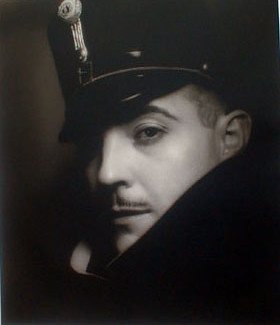
Novarro soon introduced George to Norma Shearer. Norma was married to Irving Thalberg , the head of MGM Studios. MGM was casting for an upcoming movie, “The Divorcee” and Norma wanted the role. Irving Thalberg couldn’t see his “angelic” wife playing the part of some vampy divorcee. Shearer went to Hurrell and said “make me a vamp”. Hurrell did just that, and created the sultry images that won Norma the role.

Thalberg and Shearer were so impressed with Hurrell's work that he was hired as head of the MGM portrait gallery in 1930.
After a disagreement with M-G-M publicity head Howard Strickling, Hurrell left to set up his own studio on Sunset Boulevard. The stars flocked to Hurrell for portraits.
It was the movies that remained Hurrell's first love. After six years, he moved to Warner Bros., helping build the careers of such stars as Bette Davis, Humphrey Bogart, Errol Flynn and James Cagney. Hurrell moved to Columbia, where he shaped Rita Hayworth's image.

During WW2 after he served in with the First Motion Picture Unit of the U.S. Army Air Force, he shot training films and photographed generals at the Pentagon. After the war, Hurrell returned to Hollywood, but soon found glamour photography had fallen out of fashion. He relocated to New York and continued shooting advertising and fashion layouts through the 50's.
Beginning in 1965 with an exhibition at New York's Museum of Modern-art his work has been showcased at museums throughout the world. One of the first books published "The Hurrell Style" by John Day & Company, in 1976, was followed by other commemorative books and special-edition prints of his work. It was during these years that he shot stars like Liza Minelli, Paul Newman, and Robert Redford. Even after his retirement in 1976, he continued to shoot portraits, adding to his portfolio such representatives of the new Hollywood as Sharon Stone, Brooke Shields and John Travolta.
Among his last assignments were photographing Warren Beatty and Annette Benning for Bugsy, Natalie Cole for the best-selling "Unforgettable" album and a fashion layout with Jennifer Flavin, his last photographic subject.
George Hurrell died of cancer in 1992.
You can see more Hollywood Hurrell portraits in my teeny Flicker set. You'd find much more by just googling! And for more information try this website set up by his son.
Saturday, 16 August 2008
Studio Photographers

Norma Shearer by Hurrell
I found an interesting glimpse into studio life from a photographer's point of view in the introduction to Hollywood Glamor Portraits
by John Kobal.
“…a major studio like Paramount had only two men in charge – Eugene Robert Richee in the No. 1 Gallery and William Walling in No. 2. (It was the same at the other studios.) The bulk of the Paramount portraits came from these two, who did almost everything for the sittings except hang the drapes. Walling estimated that he averaged about 65 portraits a day, six days a week, for the first three years. Sittings would be arranged for any time the stars had free between films; or after a day on the set they would appear at 6.00 at the gallery for portrait sessions that would continue until there were enough good shots.

Marlene by William Walling
“The value of the stills photographers to their employers lay in their ability to make people want to see the star, by creating a photograph equivalent of the accumulative impact of the whole movie. It was the Harlow of Hurrell’s photographs you sought in the films, and her close-up, when it came in the plot took a lot of its lighting ideas from the Hurrell original. It was, as a matter of fact, quite common for a stills photographer of Hurrell’s stature to be brought out to the set to assist in lighting the close-ups.

Harlow by Hurrell
"There were few directors as knowledgeable or as consummately skilled in achieving the same results as the gallery photographer. Josef von Sternberg was, of course, the outstanding exception. No one ever understood the Dietrich face as he did, and the best portraits of her were those taken on the set by the publicity photographer on stand-by, employing Sternberg’s lighting set-up and pose. But the exception proved the rule; most directors and cameramen would have been delighted to achieve on film the look of a Hurrell, Bull or Bachrach. Special film images, like the one in The Spiral Staircase when one sees on the screen a close-up of the eye of the murderer in whose pupil is reflected the victim-to-be, were also done in the gallery, this particular one by Ernest Bachrach.

“Among the problems of the gallery photographers were how to deal with the stars whose image they were selling – how to liven up weary, bored or unwilling actors. Not all of them enjoyed being photographed as Crawford did. Hurrell said “She believed in the star thing, and everything that went with it. She could make artificial poses seem so real, going on and on loving it. She’d set aside a whole day, changing into maybe twenty different gowns, hairdos, make-up, everything. I probably shot more stills of her than anyone else. Let her stand stiff and aristocratic and she’d be off.”

Joan Crawford by Laszlo Willinger
"Others, like Gary Cooper and Bing Crosby, were lethargic; John Barrymore and W. C. Fields positively loathed the process. The photographers had to deal with all of them.

Gary Cooper by Clarence Sinclair Bull
"Not only great stars, already formed, came to the galleries, but also aspiring actors and actresses who did not as yet have a public image which the studios could sell. Stills would serve as a cheap screen test, capturing them in every way, every mood, costume, setting until the face clicked. The studio heads would then decide on the basis of these photographs whether a screen test was worthwhile.

Lana Turner by Madison Lacy
"The gallery photographers answered to the publicity and advertising departments. Publicity wanted a basic head shot against a flat background that would reproduce well in the cheapest pulp magazines and in newspapers. Art studies were done for fan magazines…”

Clara Bow by E. R. Richee
Friday, 15 August 2008
Today's Movie Kiss

There are so many completely different things I want to do today that I shall be brief here. First I shall tell you of the Gary Cooper site Orlando found - not the slickest site on the web but the photo page is rightly called "photobliss"...
...and then I shall leave you with a kiss which will be my way of saying "Goodbye Gary Cooper, hello Cary Grant!"
Wednesday, 13 August 2008
More Distracted Yet

First Orlando sends me a gorgeous photo of Gary Cooper from his Hollywoodland collection, then I read a post about The Great Man in my new fave blog by Sheila O'Malley, which send me scurrying over to YouTube to check out his Big Break Movie.
The film's called Wings and won an Oscar for best picture the first year of the Academy Awards, 1927.
Sheila tells us "In Wings Cooper had only one major scene. "I played the veteran flyer," he explained. "Dick and Buddy were cadets. The camera picked me up munching on a chocolate bar in their tent. I kinda salute, throw the half-eaten candy aside, and take off for some test flying. I'm killed, but all you see is the shadow of my plane. Then the camera focuses on the unfinished chocolate. I always give credit to Arlen and Rogers for their swell reaction to my death. They made me a hero."" If you want the rest of the story about how Clara Bow, Cooper's current lover (apparently, he had a few), landed him the role you can read it in the rest of Sheila's post.
I was startled to see it was a silent movie. It started me thinking about technology moving fast - people at the beginning of the last century must have had the same buzz of excitement as we feel now as media moved from silent to talkies to colour and then TV. Imagine seeing movies in your own living room for the first time...I'll bet it felt every bit as exciting as taking your iphone out of your pocket and watching your favourite TV show while waiting in line...
Enough musing.
Enjoy.
"The general consensus seems to be that I don't act at all. " Gary Cooper
I think I might start giving you a new movie kiss every day :)


1928


In Sergeant York
Distracted

I'm getting distracted from my "Photographers" project. I totally blame Orlando. This morning my inbox was stuffed with these gorgeous photos. Thank you, dear Marlowe. I just had to share! Methinks I will be updating my Flickr sets soon...


Does anyone know who this woman is?


Orlando has found this site devoted to Cooper. I feel I must share...the photo page is heaven!
Subscribe to:
Posts (Atom)